
ESA Letter Guide
What a real ESA letter looks like — an annotated sample.
Below is an example of a legitimate emotional support animal letter, with every part labeled. Use it to recognize the real thing — and to spot the fakes landlords reject. One honest note up front: this is an educational sample, not a valid letter. A real ESA letter is signed by a clinician licensed in your state after they actually evaluate you. NSAR has done it that way since 1995.
$179.95· reviewed one-on-one by a state-licensed clinician · refunded if you’re not approved
- 4.9Google · 1,505 reviews
- 4.5Yelp · 147 reviews
- A+BBB Accredited since 2017
- 254,343animals registered since 2008
A sample ESA letter, annotated
Here’s what a legitimate emotional support animal letter contains. The names, license number, and verification ID below are placeholders — this is an example to learn from, not a letter you can use.
Dr. Jordan Avery, LCSW
Avery Behavioral Health · Telehealth
contact@example-clinic.org · (000) 000-0000
October 1, 2026
To Whom It May Concern,
I am a mental-health professional licensed in the state where my client resides. My client has a condition that substantially limits one or more major life activities, and I am treating them for it. As part of their care, I recommend an emotional support animal. I ask that a reasonable accommodation be made under the Fair Housing Act so that my client may keep their assistance animal.
(No diagnosis is disclosed — HUD guidance does not require it.)
Jordan Avery
Dr. Jordan Avery, LCSW
Licensed Clinical Social Worker — State of (your state)
License No. SAMPLE-00000· Active
Verification ID: SAMPLE-ESA-0000 · confirm at nsarco.com/verify
Educational example only. This is not a valid letter and cannot be used.
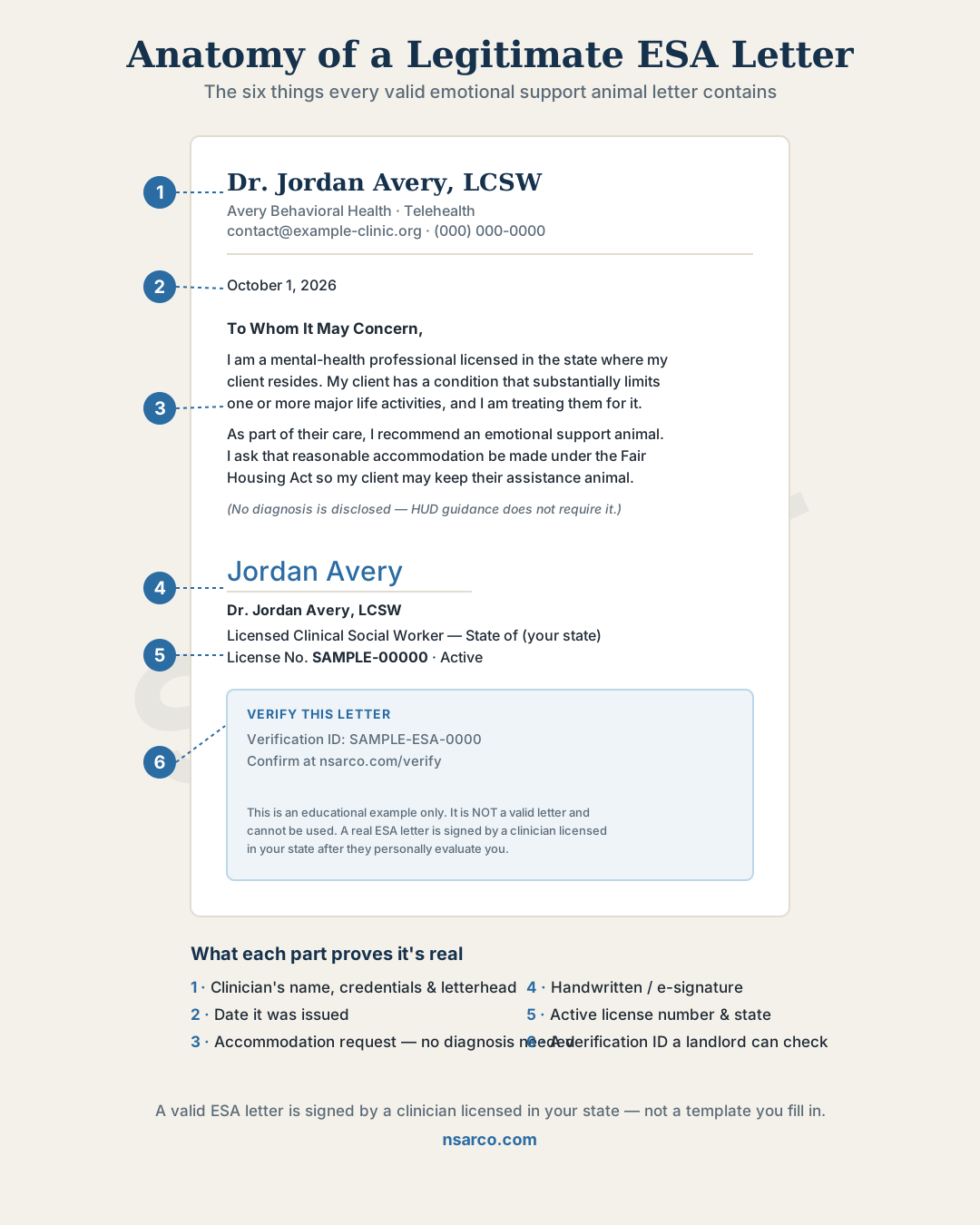
What every legitimate ESA letter includes
- 1
Licensed clinician + letterhead
The signer's name, credentials (LCSW, LMFT, LPC, psychologist, etc.) and practice contact. A real person with a real license — not an anonymous PDF generator.
- 2
Date of issue
When the letter was written. Many housing providers expect a letter issued within the last 12 months.
- 3
Accommodation statement — no diagnosis
A statement that you have a condition limiting a major life activity and that an ESA is recommended as a reasonable accommodation under the Fair Housing Act. HUD guidance means it does not disclose your diagnosis.
- 4
Signature
The clinician's handwritten or verified e-signature. An unsigned letter is just a draft.
- 5
Active license number + state
The clinician's license number and the state that issued it — and that state must be where you live. This is the single most-checked element, and the one fakes skip.
- 6
A verification ID
A reference a landlord can confirm (NSAR letters carry one, checkable at nsarco.com/verify) — so your housing provider can see at a glance that it's real.
How to tell a real ESA letter from a fake
This is where most people get burned — and where the legitimacy actually lives. Treat these as red flags:
- ✕An “instant” letter issued in minutes with no real evaluation. A licensed clinician has to actually assess you first.
- ✕No license number, or a signer you can't identify. A legitimate letter names a clinician licensed in your state and carries their license number.
- ✕A “registration,” “certificate,” or ID card sold as if it were the letter. Those are optional add-ons — the clinician's signed letter is the document that carries legal weight.
- ✕A generic, fill-in-the-blank template with no clinician behind it. A template isn't a letter; a landlord can deny it on sight.
NSAR is the opposite of all four: real clinicians licensed in your state, a genuine one-on-one review, a signed letter with a license number, and a verification ID anyone can check. We’ve done it this way since 1995 — see why NSAR is legitimate.
“Can I just download a template?”
It’s the most common question, and the honest answer saves people money: a template isn’t an ESA letter.What gives the letter its force is the licensed clinician who evaluated you and put their name and license on it — not the wording or the layout. Fill in a blank yourself and there’s no clinician behind it, so a housing provider can reject it outright (and many do).
That’s why we don’t hand out a blank to fill in: it wouldn’t help you, and it could get you denied. The sample above is to recognize a real letter — to get one, a clinician has to do the evaluation.
How to submit your ESA letter to your landlord
Once you have a legitimate letter, here’s how it’s used under the Fair Housing Act.
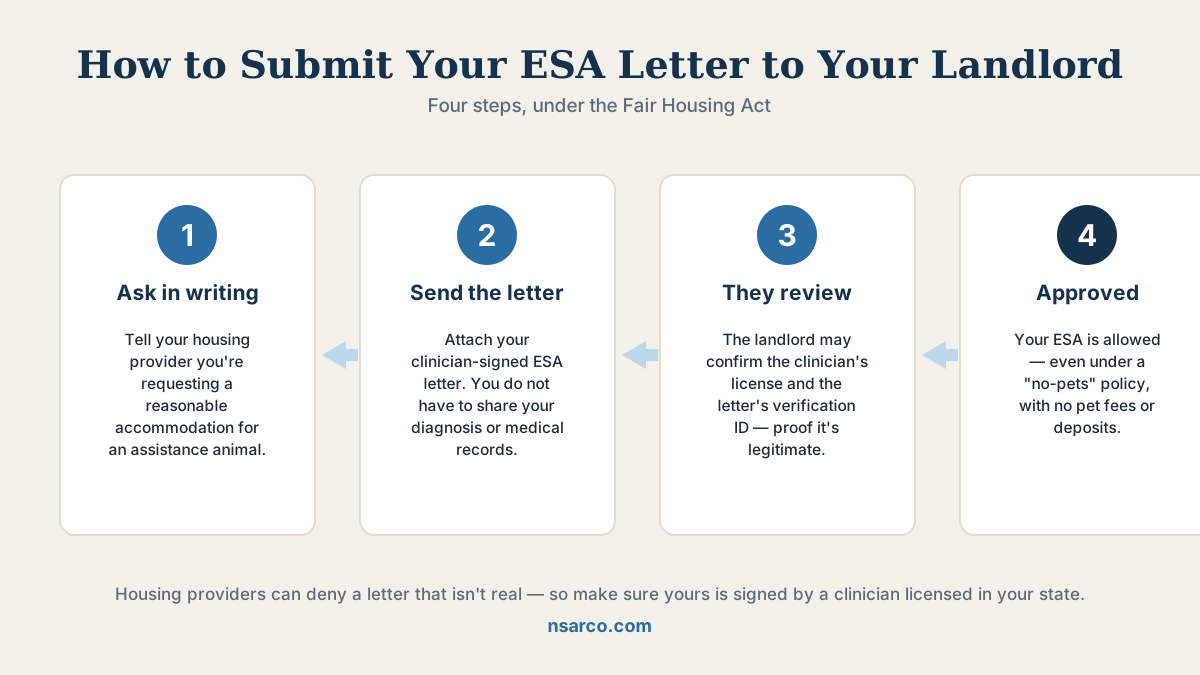
1 · Ask in writing
Tell your housing provider you’re requesting a reasonable accommodation for an assistance animal.
2 · Send the letter
Attach your clinician-signed letter. You don’t have to share your diagnosis or medical records.
3 · They review
The landlord may confirm the clinician’s license and the letter’s verification ID.
4 · Approved
Your ESA is allowed — even under a “no-pets” policy, with no pet fees or deposits.
More detail: submitting your ESA letter to a landlord and your housing rights.
Sample ESA letters, answered
- Is there a sample ESA letter I can look at?
- Yes — this page shows an annotated example so you can see exactly what a legitimate ESA letter contains: the clinician's name and credentials, their active license number and state, a reasonable-accommodation statement, a date, a signature, and a verification ID. It's an educational example only — it is not a valid letter and can't be used. A real ESA letter is one a clinician licensed in your state signs after personally evaluating you.
- Can I write my own ESA letter or use a blank template?
- No. The thing that makes an ESA letter valid is that a licensed mental-health professional evaluated you and signed it on their license — not the wording or the format. A template you fill in yourself has no clinician behind it, so it isn't a letter at all, and housing providers reject it. That's exactly why we don't offer a downloadable blank: it wouldn't help you and could get you denied.
- What does a legitimate ESA letter have to include?
- Six things: (1) the clinician's name, credentials, and letterhead; (2) the date; (3) a statement that you have a condition limiting a major life activity and that an emotional support animal is recommended as a reasonable accommodation; (4) the clinician's signature; (5) their active license number and the state it's in; and (6) ideally a verification ID a landlord can confirm. Notably, it does NOT need to name your diagnosis.
- Does an ESA letter have to list my diagnosis?
- No. Under HUD's guidance (FHEO-2020-01), a housing provider may not require details of your diagnosis. A proper ESA letter confirms that you have a condition and that the animal is a needed accommodation — without disclosing the specific diagnosis. A letter that dumps your private medical details isn't 'more official'; it's just oversharing.
- How can a landlord tell if an ESA letter is fake?
- The giveaways: no clinician license number, a 'registration' or 'certificate' presented instead of a signed clinician letter, an 'instant' letter issued with no real evaluation, or a generic PDF with no verifiable signer. A legitimate letter names a clinician licensed in your state, carries their license number, and can be verified. Landlords can and do deny the fakes.
- What does a real ESA letter cost, and how do I get one?
- A legitimate ESA letter generally runs about $99–$199 because a licensed clinician actually evaluates you. NSAR's is $179.95, reviewed one-on-one by a therapist licensed in your state, and you're refunded if they can't approve you. You complete a clinical intake, a state-licensed clinician reviews it, and — if you qualify — your signed letter is issued, usually within about a business day.
Where to next
Get your ESA letter
A therapist licensed in your state reviews your intake and, if you qualify, signs your letter — usually within a business day.
Sideways
How to get an ESA letter
The step-by-step process, who can write one, and how to avoid the five-minute letter mills.
Up one level
Emotional support animal letter
The full overview — what the letter is, your 2026 housing rights, and how it works.
Why trust us
Meet the clinicians
Real, state-licensed mental-health professionals — not a pdf mill.